Flashback to November 27
Entertainment History
On December 9, 1854, the London weekly newspaper The Examiner published a short poem signed only with the initials “A.T.” Its author was Alfred Tennyson, Britain’s poet laureate, and the poem was “The Charge of the Light Brigade,” a tribute to the cavalrymen who had ridden into disaster at Balaclava in the Crimean War.
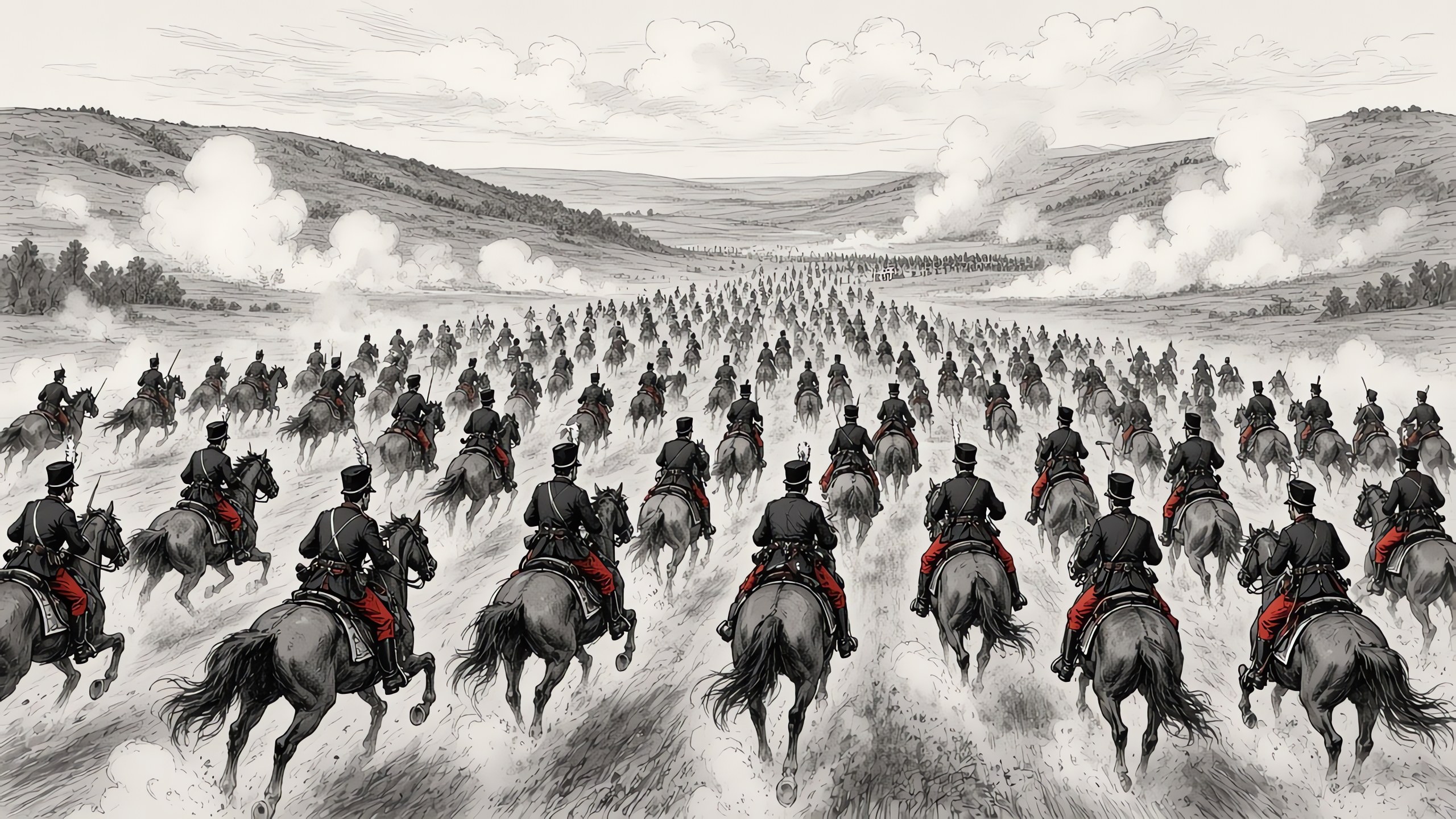
The charge had taken place on October 25, 1854. During the Battle of Balaclava, the British commander Lord Raglan sent an order to his cavalry to stop Russian troops from carrying away captured guns. The order was vague, and it was misunderstood as it passed from Raglan through the officer who carried it, Captain Louis Nolan, to the cavalry commander Lord Lucan.
As a result, the Light Brigade, led by Lord Cardigan, charged straight down a long valley toward a battery of Russian guns, with more Russian artillery and riflemen on the heights on both sides. Some 670 men rode in. More than 100 were killed, many more were wounded or captured, and hundreds of horses were lost. Nolan was among the first to die.
Reports reached Britain weeks later. The Times published an account of the battle in November, along with a leading article that spoke of the soldiers as the victims of “some hideous blunder.” Tennyson read the coverage and, according to his own account, wrote the poem in a few minutes on December 2, drawing on that phrase for one of its most famous lines.
The poem uses a driving, galloping rhythm that imitates the movement of the horses. It opens with “Half a league, half a league, half a league onward,” and it includes the lines “Theirs not to reason why, theirs but to do and die” and “Into the valley of Death rode the six hundred.”
The poem praised the courage and obedience of the soldiers while openly admitting that “some one had blunder’d.” That combination struck a chord with a public angered by the mismanagement of the war.
Tennyson revised the poem for his collection Maud and Other Poems in 1855. At the suggestion of Lady Franklin, he also sent a thousand copies of a single-sheet version to be distributed among the troops in the Crimea, where the men who had fought there could read it for themselves.
In 1890, late in his life, Tennyson recorded himself reciting the poem on a wax phonograph cylinder, one of the earliest recordings of a major poet reading his own work.
More than a century and a half later, “The Charge of the Light Brigade” remains one of the most quoted poems in the English language. Its lines have become a byword for courage in the face of hopeless orders, and for the cost of military blunders.
We strive for accuracy. If you see something that doesn't look right, click here to contact us!
 Contact Us
Sponsored Content
George Harrison releases the…
On November 27, 1970,…
Richard Strauss conducts the…
On November 27, 1896,…
Ross McWhirter, Guinness Book…
Tragic event unfolded on…
Eugene O’Neill, playwright, dies…
Acclaimed playwright Eugene O'Neill,…