Flashback to November 25
World History
1810
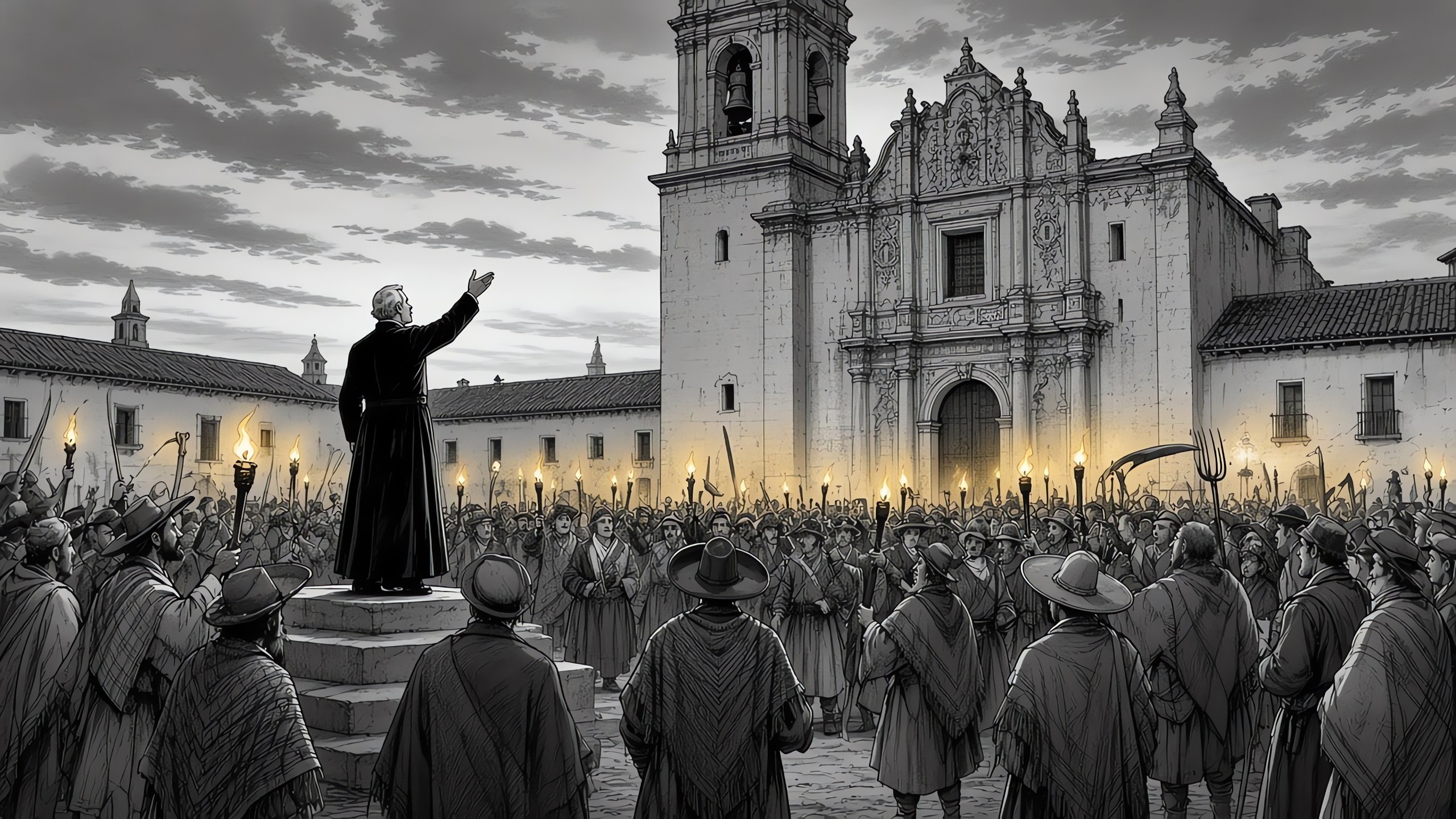
Father Miguel Hidalgo issues the Grito de Dolores, launching Mexico’s war of independence
Read moreIn the early hours of September 16, 1810, Father Miguel Hidalgo y Costilla rang the bell of his parish church in the town of Dolores, in the Spanish colony of New Spain. When his parishioners gathered, he called on them to rise up against the colonial government. His appeal, known as the Grito de Dolores, or Cry of Dolores, began Mexico’s war of independence.
Hidalgo was a well-educated priest in his late fifties who had once been rector of a college in Valladolid, now Morelia. In Dolores he encouraged local industries such as pottery, silk and wine making, and he was popular among the Indigenous and mixed-race people of his parish.
New Spain was in turmoil. In 1808 Napoleon had forced the Spanish king, Ferdinand VII, to give up his throne, and Spain itself was occupied by French troops. In the colony, American-born Spaniards known as criollos resented the power of officials and merchants born in Spain.
Hidalgo joined a group of conspirators, including the army officers Ignacio Allende and Juan Aldama, who planned a revolt for later in the year. In September the plot was discovered. Josefa Ortiz de Domínguez, the wife of the magistrate of Querétaro, managed to send a warning, and Aldama rode to Dolores with the news. Hidalgo decided to act at once.
No exact record of his words survives. Most accounts agree that he denounced bad government and the Spanish-born officials while declaring loyalty to the captive Ferdinand VII and to the Virgin of Guadalupe, whose image became the banner of the rebellion.
Thousands of poor farmers and laborers joined him within days. On September 28 the rebels stormed the Alhóndiga de Granaditas, a fortified granary in Guanajuato, killing many of the Spaniards sheltering inside. The violence frightened many criollos who had sympathized with the cause.
Hidalgo’s army, by then enormous but poorly armed, defeated royalist troops at Monte de las Cruces near Mexico City in October, but he chose not to attack the capital. In January 1811 his forces were routed at the Bridge of Calderón. He was captured in March, tried and executed by firing squad at Chihuahua on July 30, 1811.
The struggle continued under leaders such as José María Morelos, and Mexico finally won independence in 1821.
Hidalgo is honored as the father of the nation. Every year on the night of September 15, the president of Mexico rings the bell from Dolores, which now hangs at the National Palace, and repeats a version of the Grito before huge crowds. September 16 is Mexico’s Independence Day.
We strive for accuracy. If you see something that doesn't look right, click here to contact us!
 Contact Us
Sponsored Content
Suriname gains independence from…
On November 25, 1975,…
Statehood of Bosnia and…
The historical event on…
Spain grants Puerto Rico…
"Spain granted Puerto Rico…
A deadly earthquake rocks…
The devastating 1667 Shemakha…

The Mirabal sisters are…
On November 25, 1960,…
Einstein presents the field…
On November 25, 1915,…