Flashback to November 25
World History
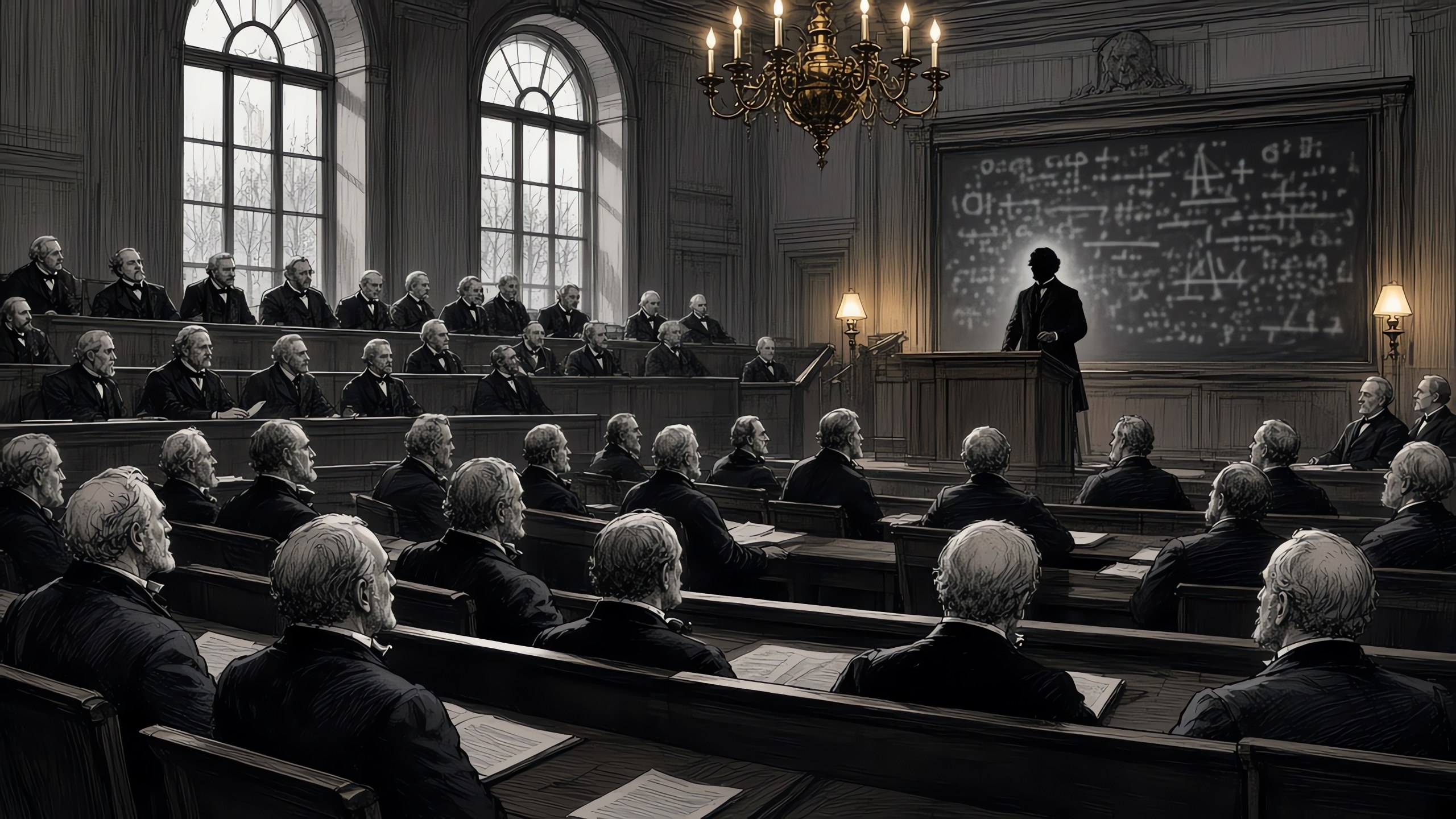
On November 25, 1915, Albert Einstein stood before the Prussian Academy of Sciences in Berlin and presented a short paper titled The Field Equations of Gravitation. In it he set out the final form of the equations at the heart of his general theory of relativity. They described gravity not as a force acting across empty space, but as the curvature of space and time produced by matter and energy.
Einstein had become famous among physicists in 1905, when his special theory of relativity showed that measurements of time and distance depend on the motion of the observer. That theory, however, did not include gravity. For the next decade Einstein worked to extend his ideas, guided by the insight that a person falling freely would not feel his own weight.
The task proved extremely difficult. Einstein had to learn advanced mathematics, including the tensor calculus developed by Italian mathematicians, with help from his friend Marcel Grossmann. In 1913 the two published a version of the theory that Einstein later realized was flawed. He spent much of 1915 trying to repair it.
The final push came in an intense burst of work. In November 1915 Einstein gave four lectures to the Academy on consecutive Thursdays. On November 18 he announced that his theory explained a long-standing puzzle, a small irregularity in the orbit of Mercury that Newton’s laws could not account for. Einstein later said the result left him so excited that he had heart palpitations.
At the same time the German mathematician David Hilbert was working on the same problem, and the two corresponded throughout the month. Historians have long discussed their exchange, but the equations Einstein presented on November 25 are the ones known today as the Einstein field equations.
The equations link the geometry of space and time on one side with the distribution of mass and energy on the other. In the words later popularized by physicist John Wheeler, matter tells space how to curve, and space tells matter how to move. Einstein published a full account of the theory in 1916.
The theory made bold predictions. One was that light passing near the sun would be bent by twice the amount expected under Newtonian physics. In 1919, British expeditions led by Arthur Eddington measured starlight during a total solar eclipse and reported results that supported Einstein. The announcement made him a celebrity around the world almost overnight.
Over the following century, general relativity became one of the foundations of modern science. It underlies the study of black holes, the expanding universe and the Big Bang. Satellite navigation systems must correct for its effects on time to give accurate positions, and in 2015, almost exactly a hundred years after the Berlin lectures, scientists detected the gravitational waves the theory had predicted.
We strive for accuracy. If you see something that doesn't look right, click here to contact us!
 Contact Us
Sponsored Content

Suriname gains independence from…
On November 25, 1975,…

Statehood of Bosnia and…
The historical event on…

Spain grants Puerto Rico…
"Spain granted Puerto Rico…
A deadly earthquake rocks…
The devastating 1667 Shemakha…

The Mirabal sisters are…
On November 25, 1960,…
Einstein presents the field…
On November 25, 1915,…