
Flashback to November 29
Entertainment History
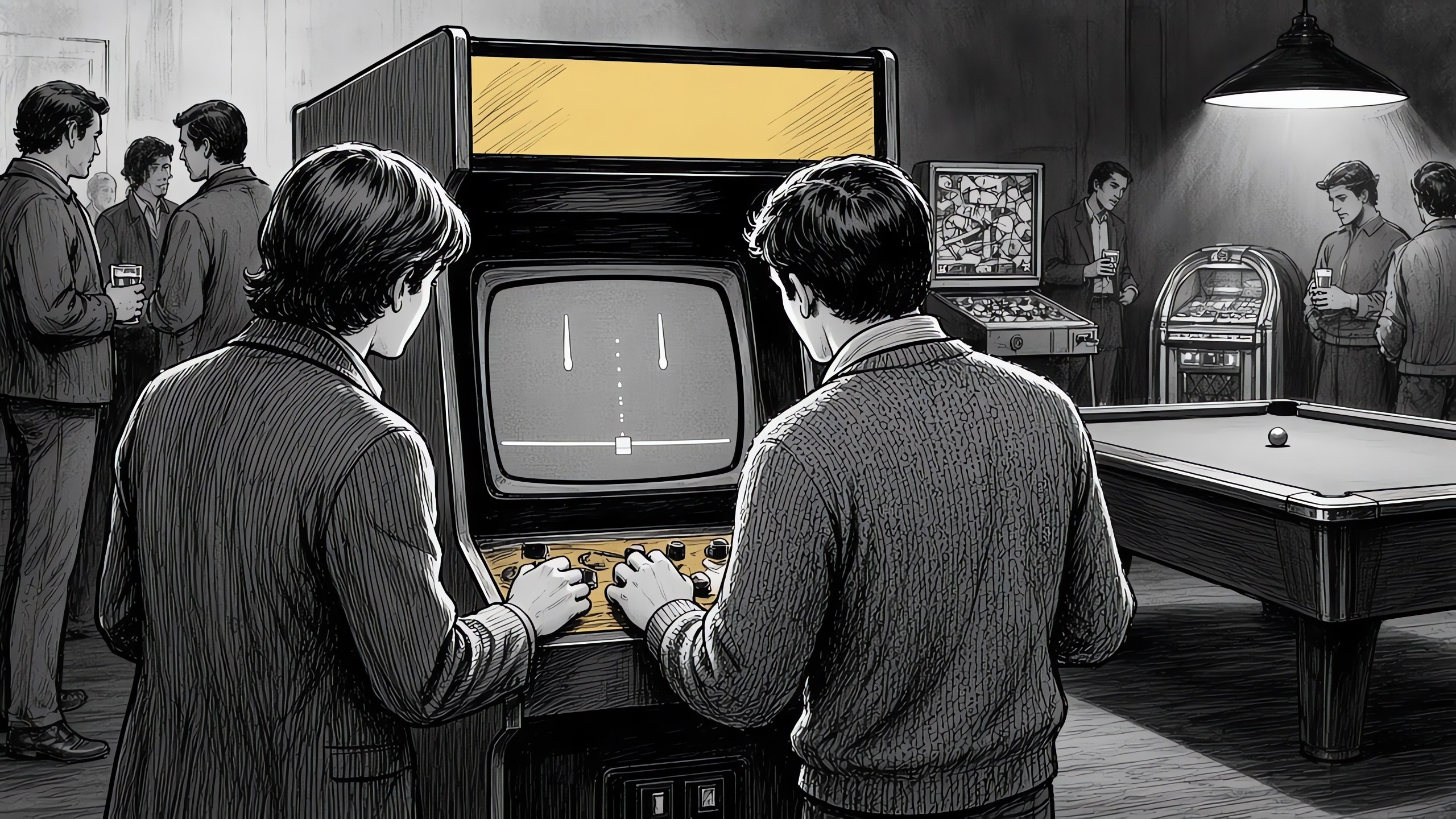
On November 29, 1972, the small California company Atari announced Pong, a coin-operated video game that let two players knock a square ball back and forth across a black-and-white screen. It was simple, cheap to play and hard to put down, and it became the first commercially successful video game, laying the foundation for the arcade and home game industry.
Atari had been founded earlier that year by Nolan Bushnell and Ted Dabney, two engineers who had already built an early coin-operated game, Computer Space, which proved too complicated to catch on. Bushnell hired a young engineer, Allan Alcorn, and gave him a training exercise: build a simple electronic table tennis game. Bushnell had seen a similar game on the Magnavox Odyssey, the first home video game console, earlier in 1972.
Alcorn went further than his assignment. He split the paddles into segments so that the ball bounced off at different angles depending on where it hit, made the ball speed up during long rallies, and found a way to produce the game’s distinctive beeps from the circuitry. He built the prototype into a wooden cabinet with a black-and-white television set bought from a local store.
Bushnell and Dabney were so pleased with the result that they decided to test it in public. In late summer 1972 they placed the prototype in Andy Capp’s Tavern, a bar in Sunnyvale where Atari already serviced other coin machines. Within days the bar’s manager called to say the machine had stopped working. When Alcorn opened it up, he found the coin box overflowing with quarters.
That convinced Bushnell that Atari should build the game itself rather than license it to an established manufacturer. With a line of credit from a bank, the company set up a small assembly line, hiring workers wherever it could find them. Production was slow at first, but orders poured in from bars, bowling alleys and amusement arcades. Atari had filled about 2,500 orders by 1973 and sold more than 8,000 cabinets by the end of 1974.
Success brought imitators. Within months other companies were selling their own versions, and Magnavox sued Atari over the resemblance to the Odyssey’s game; the case was settled out of court. Atari responded by making new games of its own, and in 1975 it released a home version of Pong through Sears that became a holiday best seller.
Pong’s influence went far beyond its sales. It showed that video games could make money, brought them into public places where ordinary people could try them, and introduced millions of players to the idea of interacting with a television screen. The arcade boom of the late 1970s and early 1980s grew directly out of its success.
Today Pong is regarded as one of the most important video games ever made. An original cabinet is part of the Smithsonian’s collection, and its two paddles and bouncing square remain one of the most recognizable images of the early digital age.
We strive for accuracy. If you see something that doesn't look right, click here to contact us!
 Contact Us
Sponsored Content

Former Beatle George Harrison…
On November 29, 2001,…
Atari releases Pong, the…
On November 29, 1972,…

Giacomo Puccini dies in…
On November 29, 1924,…

Manuel García’s company stages…
On November 29, 1825,…

Cary Grant, British-born American…
Cary Grant, the British-born…

Actress Natalie Wood drowns…
On November 29, 1981,…
