
Flashback to November 23
World History
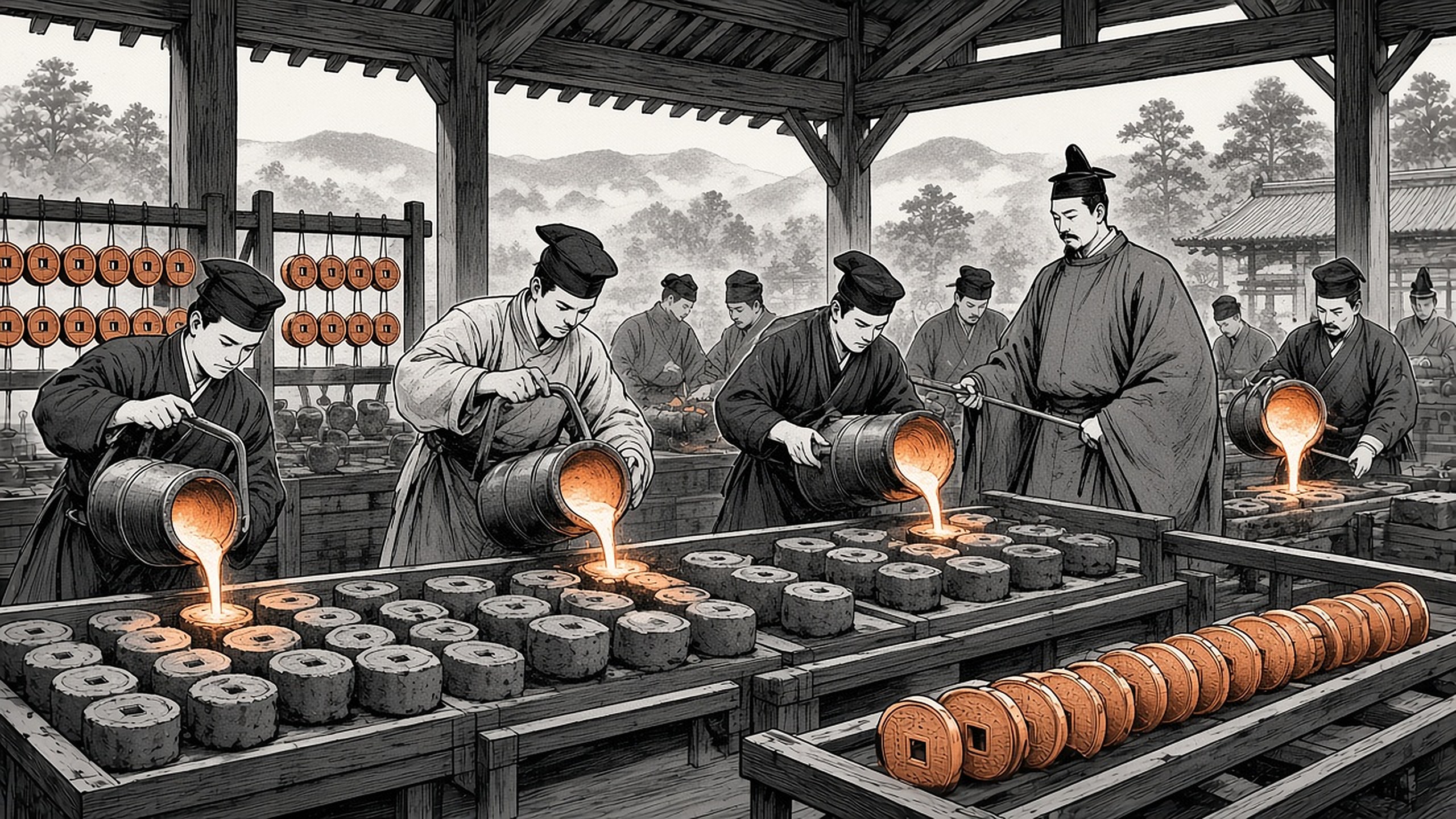
On August 29, 708, the Japanese imperial court began issuing copper coins known as Wadōkaichin. According to the official history Shoku Nihongi, the coins were put into circulation on the 10th day of the 8th month of the first year of the Wadō era, on the order of Empress Genmei. They are the oldest official coinage issued by Japan’s imperial government.
The coins were made possible by a discovery earlier that year. In the first month of 708, a deposit of copper was found in Musashi Province, in what is now the Kantō region around Tokyo, and samples were presented to the court. The find was considered so auspicious that the era name was changed to Wadō, written with characters meaning “Japanese copper.”
The court acted quickly. In the second month, it established an office to oversee the casting of coins. Silver Wadōkaichin coins appeared in the fifth month, followed by the copper coins in the eighth month.
Japan’s rulers were closely following the example of Tang dynasty China, whose government, laws, and culture they admired and imitated. The Wadōkaichin was modeled on the Chinese Kaiyuan Tongbao coin, first issued in 621. Like its Chinese model, it was round with a square hole in the center, allowing coins to be strung together, and it bore four characters. Its size and weight were almost identical to those of the Chinese coin.
The new money served practical and political purposes. The court was preparing to move to a new capital, Heijō-kyō, at Nara, which became the seat of government in 710, and coins could help pay for labor and materials. Issuing its own currency also displayed the power and sophistication of the Japanese state.
Getting people to use coins was a challenge. Much of the economy still relied on rice and cloth as forms of exchange. The government issued laws to encourage the use of coins, including granting court ranks to officials who saved them, and imposed harsh penalties for private counterfeiting. The silver coins were soon abandoned. They were restricted in 709 and banned in 710, leaving the copper coins as the official currency.
For centuries, the Wadōkaichin was regarded as the first coin made in Japan. That view changed in the late 1990s, when archaeologists excavating the Asuka-ike site in Nara Prefecture found evidence that copper coins called Fuhonsen had been produced there in the late seventh century, decades before 708. Even so, the Wadōkaichin remains the oldest known coin issued as official currency by the imperial court.
It was the first of twelve series of copper coins issued by the Japanese government over the following two and a half centuries. Today, the Wadōkaichin is a treasured find for archaeologists and collectors, and the site in Saitama Prefecture associated with the copper discovery is commemorated with a large monument in the shape of the coin.
We strive for accuracy. If you see something that doesn't look right, click here to contact us!
 Contact Us
Sponsored Content

European weather satellite Meteosat…
Launched from Cape Canaveral…

Andre Malraux, French novelist/art…
Renowned French novelist and…

British bombers again attack…
On the evening of…

An Anglo-Ethiopian boundary commission…
On November 23, 1934,…

King William III of…
"King William III of…

In Dumbarton, Scotland, the…
Experience a piece of…
