
Flashback to November 23
American History
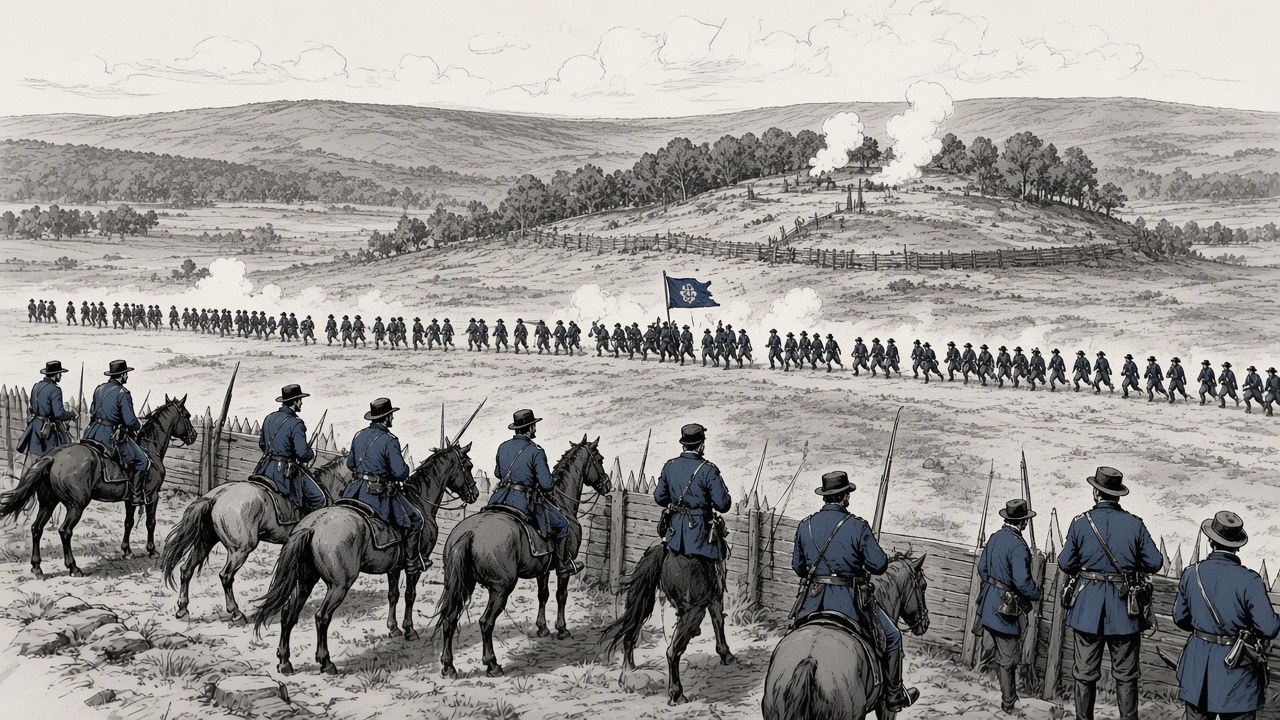
On November 23, 1863, the long siege of Chattanooga, Tennessee, began to break. That afternoon, Union troops marched out of their fortifications and seized a rocky hill known as Orchard Knob, opening the Battle of Chattanooga, one of the most important Union victories of the American Civil War.
The Union Army of the Cumberland had been trapped in Chattanooga since its defeat at Chickamauga in September. Confederate General Braxton Bragg’s Army of Tennessee held the high ground around the city, with its main line stretched along Missionary Ridge and its guns on Lookout Mountain. Supplies ran so short that soldiers went hungry, and the city’s fate became a serious concern in Washington.
In October, General Ulysses S. Grant was given command of all Union forces in the Western Theater. He replaced General William Rosecrans with General George H. Thomas, opened a new supply route that soldiers nicknamed the “Cracker Line,” and began planning a breakout as reinforcements arrived.
On November 22, reports from Confederate deserters suggested that Bragg might be pulling troops away from his lines. Grant worried that Bragg was sending soldiers to reinforce General James Longstreet near Knoxville. To find out whether the Confederates were still willing to fight, Grant ordered Thomas to make a reconnaissance in force against the Confederate picket line in front of Missionary Ridge.
The target was Orchard Knob, a craggy knoll rising about one hundred feet above the valley floor, roughly a mile from the Union lines. Around midday, the divisions of General Thomas J. Wood and General Philip Sheridan formed ranks on the open plain with such precision that Confederate observers reportedly believed they were watching a grand review. Grant, Thomas, and other senior officers watched from the parapets of Fort Wood.
At about 1:30 P.M., buglers sounded “Forward,” and roughly 14,000 Union soldiers surged across the valley. Only about 600 Confederates held the rifle pits around the knob. The defenders managed to fire on the advancing lines, but they were quickly overwhelmed. Those who were not shot or captured fell back toward the base of Missionary Ridge.
A few minutes before 3:00 P.M., Wood signaled that he had carried the first line of the enemy’s entrenchments. The plan had called for a reconnaissance, not a permanent advance, and Grant and Thomas briefly considered pulling the troops back. Instead, Grant decided to keep the ground. “Intrench them and send up support,” he ordered.
The capture of Orchard Knob gave the Union army a valuable position in the middle of the valley. It also showed Grant that Bragg’s army was still in place and prepared to fight, and it prompted Bragg to recall troops and strengthen his defenses on Missionary Ridge.
The fighting that began on November 23 continued over the next two days. On November 24, Union troops under General Joseph Hooker captured Lookout Mountain in what became known as the “Battle Above the Clouds.” On November 25, Grant directed the battle from Orchard Knob as Union soldiers charged up Missionary Ridge and broke the Confederate line, sending Bragg’s army into retreat.
The victory lifted the siege of Chattanooga and secured a key railroad hub that opened a gateway into the Deep South. It also cemented Grant’s reputation as the Union’s most effective general. The following year, Chattanooga became the launching point for General William T. Sherman’s Atlanta Campaign. Today Orchard Knob is preserved as part of the Chickamauga and Chattanooga National Military Park.
We strive for accuracy. If you see something that doesn't look right, click here to contact us!
 Contact Us
Sponsored Content
Battle of Chattanooga begins…
On November 23, 1863,…
