Flashback to November 24
World History
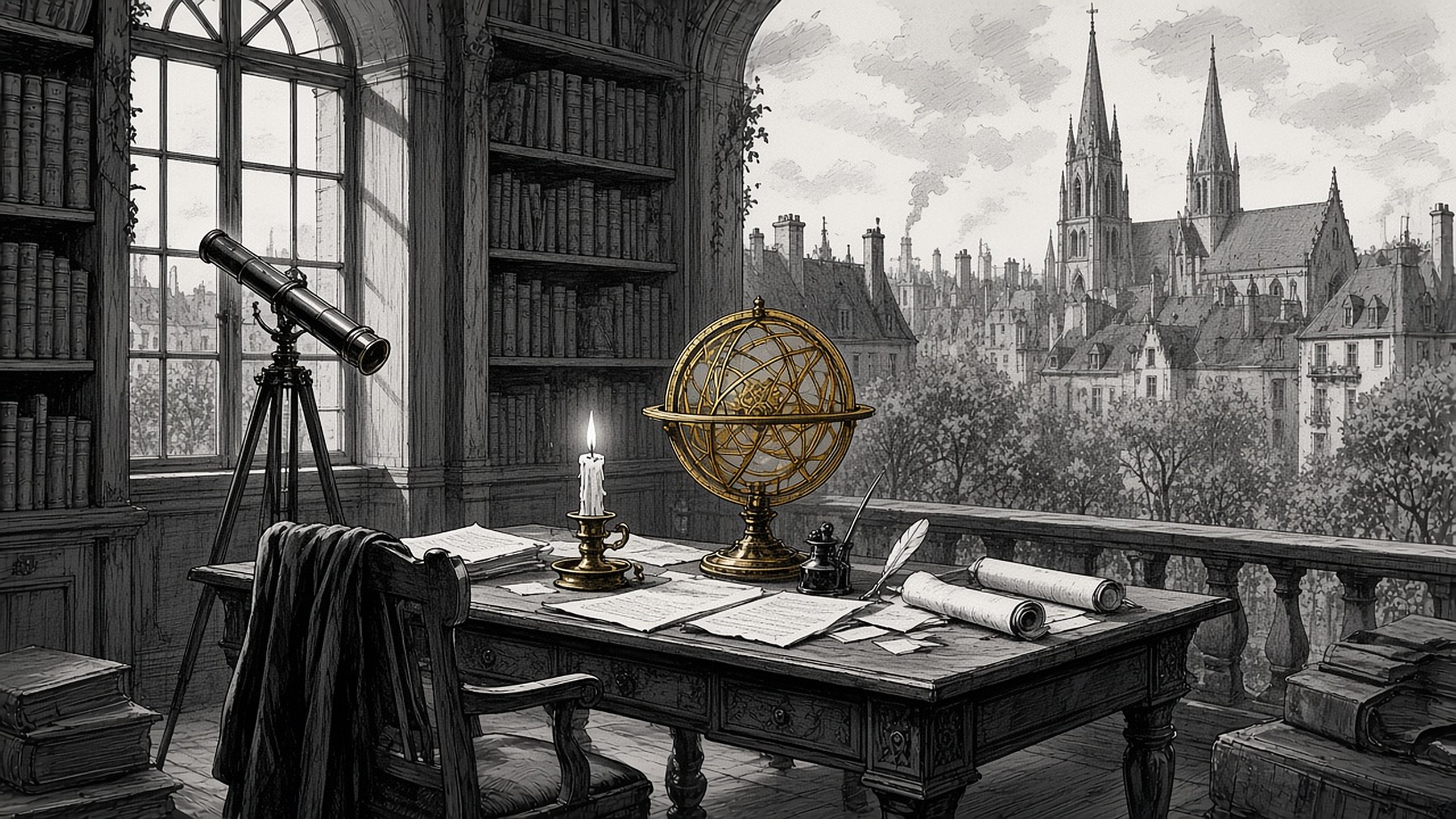
On October 24, 1655, Pierre Gassendi died in Paris at the age of 63. A Catholic priest, he was also one of the leading philosophers and scientists of his time. He was a friend and critic of René Descartes, an astronomer who made important observations, and the scholar who brought the ancient theory of atoms back into European thought.
Gassendi was born on January 22, 1592, in Champtercier, a village in Provence in southern France. A gifted student, he studied theology and philosophy at Aix-en-Provence and was ordained a priest. In his twenties he taught philosophy at the university of Aix. He became a canon of the cathedral of Digne, near his birthplace.
From early on, Gassendi rejected the philosophy of Aristotle that dominated the universities. He believed that knowledge should be based on careful observation and experience. His first book, published in 1624, was an attack on Aristotelian philosophy.
He was also a keen astronomer. On November 7, 1631, he observed the planet Mercury passing across the face of the sun from Paris, as Johannes Kepler had predicted. It was the first transit of a planet ever observed. His observation showed that Mercury was far smaller than many astronomers had believed.
Gassendi traveled widely, visiting scholars in the Netherlands and Flanders, and he made astronomical observations wherever he went. Gassendi corresponded with many of the leading thinkers of Europe, including Galileo, Kepler’s followers and the friar Marin Mersenne, whose network of letters linked scholars across the continent. In 1641 Descartes published his Meditations on First Philosophy with replies to critics. Gassendi wrote the fifth set of objections, challenging Descartes’ claim that the mind could be known with more certainty than the body. The exchange between the two men became famous.
His greatest project was to revive the ideas of the Greek philosopher Epicurus, who had taught that the world is made of tiny, indivisible atoms moving in empty space. Gassendi adapted the theory to Christian belief, arguing that God had created the atoms and set them in motion. His work helped make atomism respectable again and influenced Robert Boyle, Isaac Newton and John Locke.
In 1645 he was appointed professor of mathematics at the Collège Royal in Paris, but poor health forced him to give up teaching after a few years. He died in the Paris home of his friend and patron Henri-Louis Habert de Montmor and was buried in the church of Saint-Nicolas-des-Champs.
His collected works were published in six volumes in 1658. A crater on the moon is named after him.
We strive for accuracy. If you see something that doesn't look right, click here to contact us!
 Contact Us
Sponsored Content

Operation Dragon Rouge: Belgian…
On November 24, 1964,…
Mali becomes an autonomous…
Marking a significant moment…

World War II: Bombing…
On November 24, 1944,…
Anastasius II begins his…
Celebrating a landmark moment…
Charles Darwin publishes On…
On November 24, 1859,…
Abel Tasman sights Van…
On November 24, 1642,…