
Flashback to November 24
World History
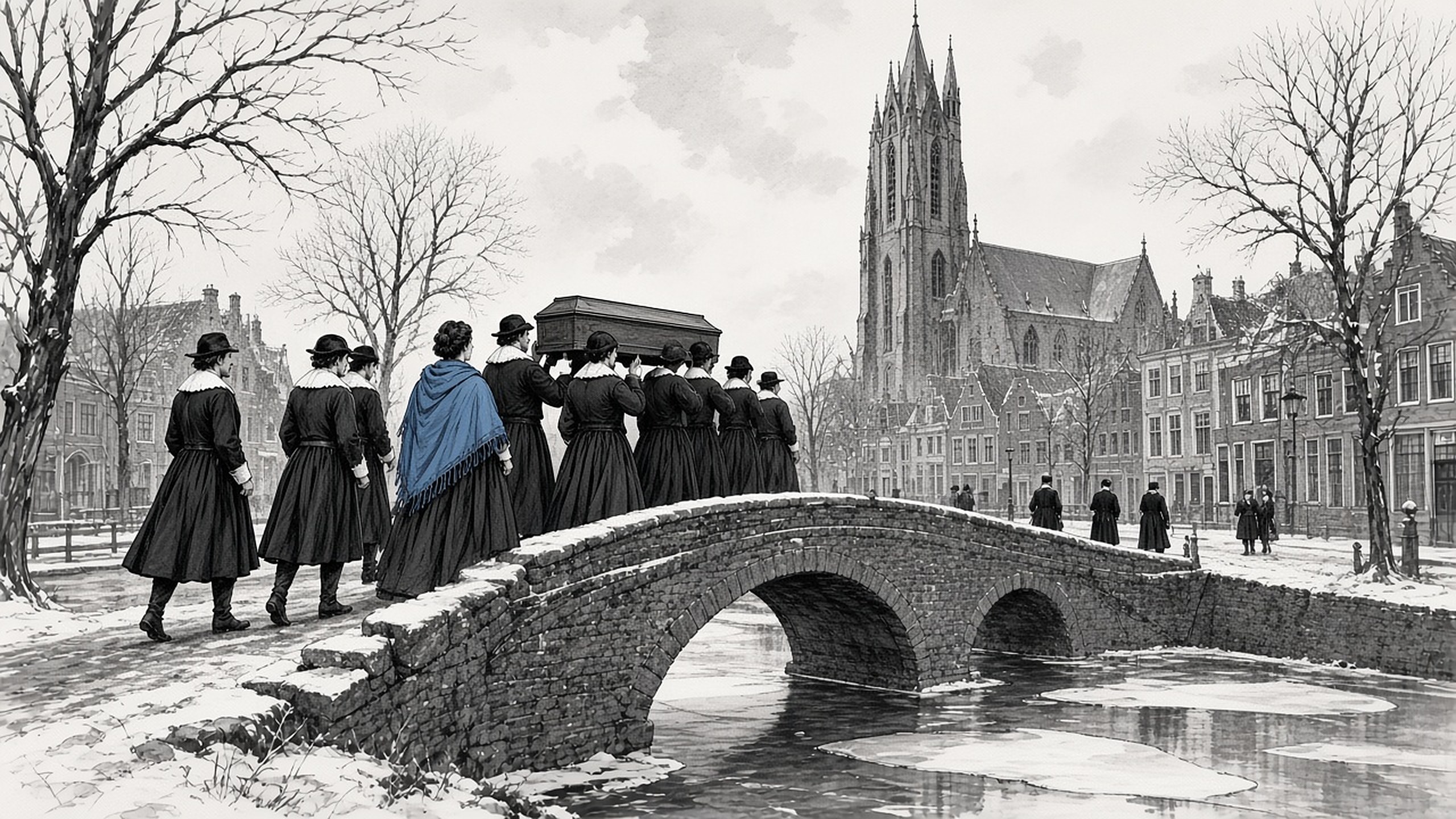
On December 15, 1675, the painter Johannes Vermeer was buried in the Oude Kerk, the Old Church, in his native city of Delft. He had died a day or two earlier at the age of 43, after a short illness. The burial register records only the date of his burial, so the exact day of his death is not known. He left his wife and a large family of young children with heavy debts.
Vermeer was baptized in Delft on October 31, 1632. His father was a silk weaver who also dealt in paintings and ran an inn. In 1653 Vermeer married Catharina Bolnes, a Catholic, and the same year he joined the Guild of St. Luke, the painters’ guild of Delft, as a master. He later served several terms as one of its leaders.
He worked slowly. Only about 35 paintings are now attributed to him, most of them quiet scenes of domestic life in the rooms of Delft houses, filled with soft light from a window on the left. Among the best known are The Milkmaid, The Love Letter, The Art of Painting, the View of Delft and Girl with a Pearl Earring.
Vermeer was respected in Delft, but he never became rich from his art. He depended partly on a small number of local patrons. He and his wife lived with her mother, Maria Thins, whose support helped the family survive. They had fifteen children, eleven of whom were alive when he died.
The French invasion of the Dutch Republic in 1672, known as the Disaster Year, ruined the art market. Vermeer could sell neither his own works nor the paintings he dealt in, and he fell deeper into debt. His widow later stated that the strain of these losses threw him into a frenzy, and that within a day and a half he went from being healthy to dead.
After his death Catharina Bolnes declared herself unable to pay the family’s debts. The scientist Antonie van Leeuwenhoek, also from Delft, was appointed trustee of the estate. Several of Vermeer’s paintings were handed over to creditors, and The Art of Painting became the subject of a legal dispute.
For almost two centuries Vermeer was largely forgotten outside a small circle of collectors. In the 1860s the French critic Théophile Thoré-Bürger published studies that brought him back to public attention. Today Vermeer is counted among the greatest painters of the Dutch Golden Age, and his few surviving works are among the most treasured in the world’s museums.
We strive for accuracy. If you see something that doesn't look right, click here to contact us!
 Contact Us
Sponsored Content

Operation Dragon Rouge: Belgian…
On November 24, 1964,…

Mali becomes an autonomous…
Marking a significant moment…

World War II: Bombing…
On November 24, 1944,…
Anastasius II begins his…
Celebrating a landmark moment…

Charles Darwin publishes On…
On November 24, 1859,…
Abel Tasman sights Van…
On November 24, 1642,…
