
Flashback to November 25
American History
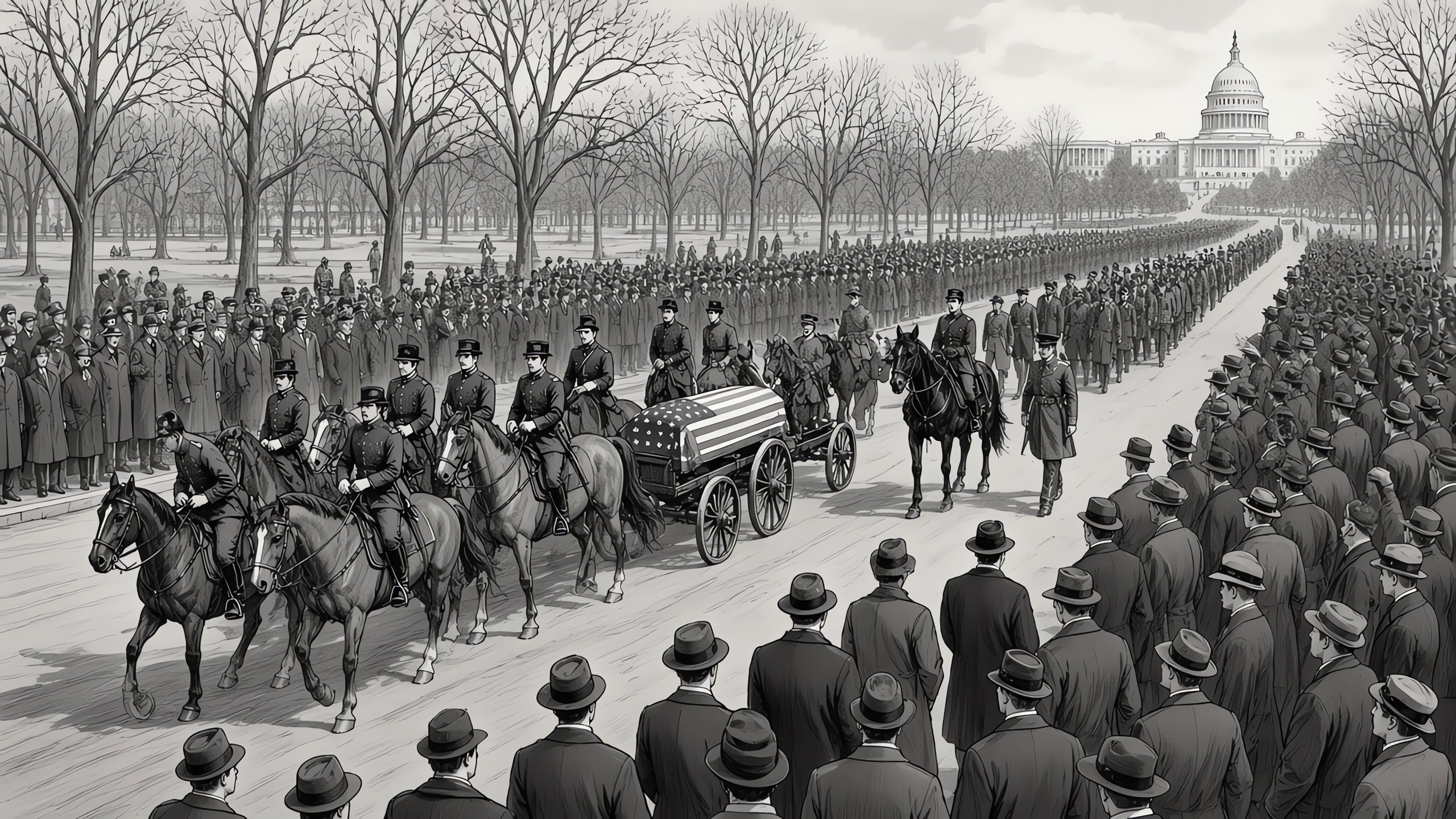
On November 25, 1963, President John F. Kennedy was buried at Arlington National Cemetery, three days after he was assassinated in Dallas. His state funeral brought Washington to a standstill and was followed on television by tens of millions of Americans and audiences around the world. It became one of the defining public moments of the decade.
Kennedy was shot while riding in a motorcade through Dealey Plaza on November 22. His body was flown back to Washington that night, and the new president, Lyndon B. Johnson, declared Monday, November 25, a national day of mourning. Because there was no funeral plan in place, military planners worked with Jacqueline Kennedy, who asked that elements of Abraham Lincoln’s funeral be included.
The president’s casket lay in repose in the East Room of the White House on Saturday. On Sunday a horse-drawn caisson carried it along Pennsylvania Avenue to the Capitol, where Kennedy lay in state in the Rotunda. About 250,000 people filed past the casket through the night, some waiting in line for ten hours in near-freezing temperatures.
On Monday morning the caisson returned to the White House, and from there the funeral procession continued on foot to St. Matthew’s Cathedral. Jacqueline Kennedy walked behind the casket with the president’s brothers, Robert and Edward. President Johnson walked as well, despite security concerns, along with leaders and representatives from more than 90 countries, including French president Charles de Gaulle, West German chancellor Ludwig Erhard, Ethiopian emperor Haile Selassie and Britain’s Prince Philip.
Behind the caisson came Black Jack, a riderless horse with boots reversed in the stirrups, a traditional symbol of a fallen leader. Cardinal Richard Cushing of Boston, a close friend of the family, celebrated a low Requiem Mass at the cathedral. Auxiliary Bishop Philip Hannan read passages from Kennedy’s speeches, including his inaugural address.
As the casket was carried out of the cathedral, the president’s son, John Jr., who turned three that day, stepped forward and saluted. The image, captured by photographers, became one of the most famous of the century.
The procession then crossed the Potomac to Arlington. Military aircraft flew overhead, followed by Air Force One, which dipped its wings in tribute. Irish army cadets, invited at Mrs. Kennedy’s request in honor of the family’s ancestry, performed a silent drill at the graveside, and bagpipers played. After a final salute and the playing of taps, the flag from the casket was folded and presented to the widow.
Jacqueline Kennedy then lit an eternal flame at the head of the grave. Kennedy was only the second president, after William Howard Taft, to be buried at Arlington. The flame still burns on the hillside below Arlington House, and the grave became one of the most visited sites in the cemetery.
We strive for accuracy. If you see something that doesn't look right, click here to contact us!
 Contact Us
Sponsored Content
American College of Surgeons…
On November 25, 1912,…
Thomas A Hendricks 21st…
Marking a pivotal moment…
Indian Wars: United States…
Experience the historical event…
The United States Greenback…
Established on November 25,…
President John F. Kennedy…
On November 25, 1963,…
The last British troops…
On November 25, 1783,…
