
Flashback to November 24
Sports History
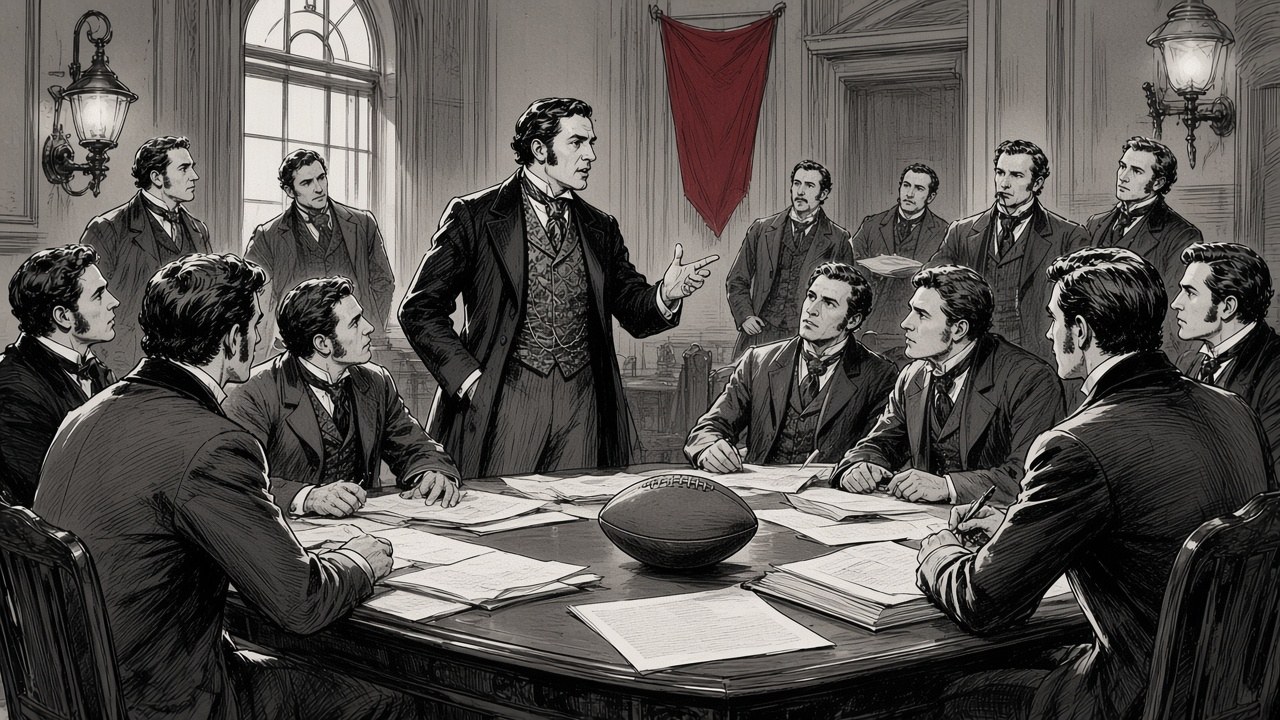
1876
Harvard, Yale, Princeton and Columbia meet at Massasoit House to create rules for college football
Read moreOn November 23, 1876, a small meeting in a Massachusetts hotel helped turn a rough collection of campus games into American football. That day, delegates from Harvard, Yale, Princeton, and Columbia gathered at the Massasoit House in Springfield, Massachusetts, and formed the Intercollegiate Football Association to agree on a common set of rules.
At the time, “football” meant different things at different schools. The famous 1869 game between Princeton and Rutgers had been played under rules closer to modern soccer, with players kicking and batting a round ball. Harvard preferred its own “Boston game,” which allowed more handling of the ball. Because each school had its own customs, teams often had to negotiate the rules before they could play one another.
Harvard’s games against McGill University of Montreal in 1874 changed the conversation. The Canadians played rugby, and the Harvard players liked it. In 1875, Harvard persuaded Yale to play a rugby-style game, and two Princeton students who watched the contest returned home convinced that their school should adopt the rugby game as well. By the fall of 1876, momentum was building for a single code.
At the Massasoit House, the delegates adopted the rules of England’s Rugby Football Union almost in full. Teams would field fifteen players a side, and players could pick up the ball and run with it. The most important change came in the scoring. Under the new rules, the rugby “try” was called a touchdown, and a match would be decided by the majority of touchdowns. A kicked goal was still worth four touchdowns, but the touchdown had taken a central place in the game, a shift that would grow more pronounced over the following decades.
The meeting produced the first comprehensive effort to organize and standardize the sport. Not everyone agreed on every point. Yale objected to the number of players per side and preferred eleven, and it did not formally join the association until 1879. Even so, the rules agreed upon in Springfield spread quickly among other colleges and athletic clubs. The University of Pennsylvania was among the schools that soon took up the new game.
The Massasoit House became the site of annual rules conventions in the years that followed. Yale’s Walter Camp, later known as the “Father of American Football,” became a fixture at these meetings and pushed through the changes that gave the game its distinct identity. In 1880, the convention reduced teams to eleven players and replaced the rugby scrum with a line of scrimmage and a snap to the quarterback. In 1882, Camp’s proposal for a system of downs required teams to gain a set distance or give up the ball.
The Intercollegiate Football Association lasted until 1893, and its member schools would later form the core of the Ivy League. The sport it helped organize grew into one of the most popular in the United States, from Saturday college games to the modern professional league. Much of that history traces back to a November afternoon in 1876, when a handful of students sat down in Springfield and decided that everyone should finally play by the same rules.
We strive for accuracy. If you see something that doesn't look right, click here to contact us!
 Contact Us
Sponsored Content
Wilt Chamberlain grabs an…
On November 24, 1960,…
Stanford’s quarterback Jim Plunkett…
Celebrating the milestone achievement,…
The Montreal Alouettes win…
The Montreal Alouettes claimed…
